Latest Post
Showing posts with label NUEVO. Show all posts

Eichner: Six Quartets for Flute, Violin, Viola & Cello


Ernst Eichner was a composer of the so-called Mannheim School who fell into obscurity as the Romantics discarded the light music of the Classical era, and whose music has until now been overlooked in the general late eighteenth century revival -- probably because the focus on music of the period has shifted from Mannheim to Vienna. But of course the influence of the Mannheim composers was continent-wide; Mozart's symphonies and keyboard sonatas from the late 1770s, for example, can't be understood without it. 


The chief musical attraction in Mannheim was the court orchestra maintained by the Elector of the Palatinate, outsized to match the Elector's mega-palace (at the end of World War II it was about the only thing standing). This set of six quartets for flute, violin, viola, and bass, composed in 1771, bears many traces of the Mannheim symphonic style; the melodies for the flute are chunky and a bit rudimentary, but they are nicely set off against very active arpeggio figures from the three strings. The music is high energy and upbeat, with hardly a slow movement present among the 12 on the disc -- each of the six quartets has only two movements.

There's not a lot of contrast among them, and the threat of what some unsung genius of country songwriting once called mutiny on the monotony is present for the listener, but those whose boat is rocked by Classical-era chamber music will find some intriguing movement types here (track 8 reproduces what must be one of the earlier movements marked scherzando), and the hour of listening offered is never less than pleasant and invigorating. Flutist Jan de Winne plays a modern copy of a period flute. --allmusic.com


Boccherini: Los últimos trios


This sumptuous Spanish release presents four trios from late in Luigi Boccherini's career. The three players La real cámara actually come from three different countries: they are Spanish, Italian, and German—appropriate for Boccherini, an Italian who worked in Spain for much of his life in the late eighteenth century and had to contend with a musical world in which the center of innovation was shifting to far-off German-speaking lands. The very detailed and informative liner notes by violinist Emilio Moreno truculently disparage anyone who classifies Boccherini as a minor composer. It's better to let the music speak for itself, which it does reasonably well.


The chief interest of these trios, as Moreno points out, is that they were written for the antiquated combination of two violins and a cello—but nevertheless manage to build large, late-Classical structures that introduce lots of variety and still hold together. The key is Boccherini's skilled writing for his own instrument, the cello. If you've heard one or two of the more famous Boccherini chamber works (like the quintet subtitled "La ritirata de Madrid"), you'll certainly enjoy the way Boccherini can make his cello sing sweetly or churn away in quasi-symphonic sounds in these works.

His melodic inspiration flags at times, but on the whole this is an attractive disc of Classical-era chamber music that rediscovers some buried works. Glossa's sound engineers, working in the Iglesia de San Miguel in the Spanish city of Cuenca, create an ideal environment for a small string group. --James Manheim, All Music Guide


Rosetti: Horn Concertos


[Hornists Sarah Willis and Klaus Wallendorf] "abide by all requirements and sound qualities, making even the most eccentric, ornamental and devilish flourishes and runs authentic and listenable. A Rosetti surprise." --Classical Day, Germany

"The soloists play superbly. Moesus leads fine support, and the recording is top notch. This, and the other CPO recordings by these two players, are well worth having, and the notes are also very detailed and well written " --American Record Guide, 12/2009


CPO follows up its recording of Rosetti’s double horn concertos (999 734-2) with a new release featuring two more double horn concertos and two solo concertos.

Rosetti, the Bohemian composer and contemporary of greats such as Mozart and Haydn left his native country in 1733 and joined the Hofkapelle of Prince von Öttingen-Wallerstein, whom he served for sixteen years. It was during this post he met two of the best horn virtuosos of the Wallerstein court; Joseph Nagel and Franz Zwierzina, so it is not surprising he composed numerous horn concertos.

The concertos on this disc are interpreted by two members of the Berlin Philharmonic; Klaus Wallendorf and English horn player Sarah Willis. Both players demonstrate their virtuoso capabilities in lengthy and technically demanding passages. Motivic and dynamic contrasts as well as expressive cantilenas for the solo instruments also make these concertos stand out - a welcome addition to CPO’s Rosetti collection.


Galuppi: Harpsichord Concertos Nos. 1-8 (complete)


Baldassare Galuppi was born on the Italian island of Burano in 1706, and died in Venice in 1785. His life was an extremely eventful and productive one for the son of a humble barber and violinist in the village band. After his father gave him his first musical education, he composed his first opera at the age of 16, following this by taking up studies with Lotti. A steady flow of operas followed, and Goldoni became his regular librettist – distinguishing his operas from a literary viewpoint as well as a musical one. He lived in London from 1741-3, and in St Petersburg from 1765-8. He later became Vice Chapel Master in St Marks, Venice in 1748 before becoming Chapel Master in 1762.


Apart from Galuppi’s vast body of work for the opera house, he was also a prolific composer of concertos and chamber music.These CDs contain his entire harpsichord concertos, which are generally in the traditional fast– slow–fast pattern of the classical concerto. Cadenzas had started to become fashionable in the mid 18th century, and the soloist has taken the liberty of utilising cadenzas composed by Muzio Clementi for use in these recordings.


Kodaly: Hary Janos Suite, Etc.

 
This sunny and brilliantly played disc gives you Kodaly's three most popular orchestral works, all in supercharged performances overflowing with color and excitement. Given the fact that Georg Solti, a real Hungarian, spent the better part of his life at the helm of this very orchestra, it's curious that it took Neeme Järvi (an Estonian) to make an all-Kodaly record with them.


In any event, circumstances could hardly have turned out better. Järvi pushes the orchestra hard--the Galanta Dances really fly--but Chicago is one of those super-virtuoso orchestras that loves a challenge, and you can practically hear them taking Järvi's dare and running with it. A disc that's pure fun. -- David Hurwitz


Connesson: Orchestral Works

 
“Performances here are of the highest order, with Erik Le Sage, who gave the concerto's premiere, on glittering form and the RSNO on their toes throughout. Chandos's SACD recording is vividly spectacular.” --Penguin Guide, 2011 edition

“If there’s another living composer who combines fantasy with shimmering orchestral virtuosity as brilliantly as Guillaume Connesson, I’ve yet to hear him.” --The Telegraph, January 2010 ***


Eric Le Sage (piano)

Royal Scottish National Orchestra, Stéphane Denève

Recognised as one of the youngest and most gifted contemporary composers, Guillaume Connesson brings together an imaginatively diffuse range of influences, from the riches of the musical traditions of his native France to John Adams, Steve Reich and the funk of James Brown. During the composition of the works making up the Cosmic Trilogy Connesson also drew inspiration from such sources as the paintings of Kandinsky and the physics of Stephen Hawking.

After first discovering Connesson’s music in 2001, Stéphane Denève remarked on its ‘amazing orchestration… the quality of writing for large orchestra on the level of a Ravel or Stravinsky!’ During his tenure at the Royal Scottish National Orchestra Denève has regularly championed Connesson’s works and two parts of the Cosmic Trilogy, ‘Aleph’ and ‘Une lueur dans l’âge sombre’, were commissioned by the RSNO. These are dedicated to Denève; in fact, the symphonic dance ‘Aleph’ was a marriage gift.

The Cosmic Trilogy evokes three moments in the history of the universe: the Big Bang in ‘Aleph’, the appearance of light and the stars in ‘Une lueur dans l’âge sombre’, and finally the explosion and death of a star in ‘Supernova’. Connesson’s works have been quickly appreciated by music lovers and performers for the exciting vitality they imbue, and the easy-going tonal strains that permeate them. The Guardian described the work as ‘bright-toned and imaginatively scored… crowd-pleasing, colourful music’. Chandos is delighted to presents the first recording of the complete trilogy.

Guillaume Connesson studied piano, history of music, choir analysis and direction at the Conservatoire National de Région de Boulogne-Billancourt, as well as orchestration at the Conservatoire National de Paris. He is currently professor of orchestration at the Conservatoire National de Région d’Aubervilliers.


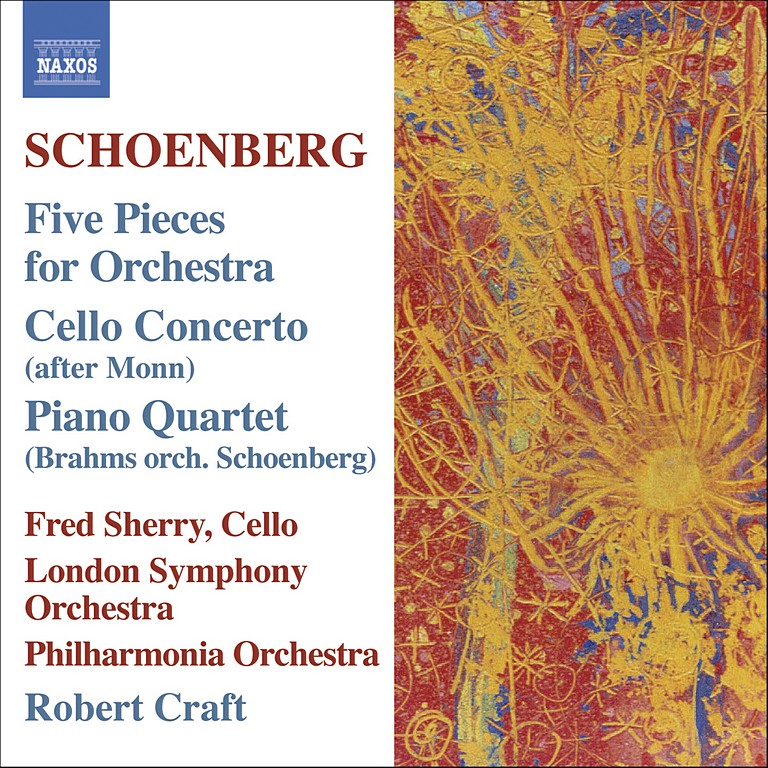
Schoenberg: Five Pieces, Cello Concerto, Brahms Quartet Transcription

 
This is Schoenberg for people who hate Schoenberg. The Five Pieces for Orchestra, far from sounding radical or appallingly dissonant as they must have in 1909, now impress us as impressionistic, atmospheric, and evocative. The loony Cello Concerto after Monn and the Brahms Piano Quartet are both modern classics in the art of transcription, not to mention one composer's very strongly personalized view of his predecessors.


Robert Craft's performances are uniformly impressive, particularly in the Cello Concerto. Its appallingly difficult solo part is handled with consummate intelligence and virtuosity by Fred Sherry, and the accompaniment hardly could be clearer or cleaner in texture. The Brahms is very good too, surpassed only by Craft himself in his earlier Sony recording with the Chicago Symphony. This newcomer, however, does enjoy much better sonics, and at the Naxos price makes an excellent bargain. --David Hurwitz, ClassicsToday.com

“A good selection of Schoenberg works here receive excellent performances on this Naxos release under Robert Craft’s expert direction.” --Musicweb International


Cyril Scott: Chamber Works


“Only the amiable 1951 Clarinet Quintet for Gervase de Peyer has been recorded before, but it’s the 1955 Clarinet Trio, first performed in New Zealand, that seems the most striking and characterful work here. The excellent Gould Trio are the stalwarts of this enjoyable disc.” --BBC Music Magazine, March 2010 *****

“Chandos continues to fly the flag for neglected 20th-century British music with this excellently played selection of Cyril Scott's chamber music...Those who maintain that Scott's music has been unjustly ignored for more than half a century...will no doubt welcome this collection.” --The Guardian, February 2010 ***


While still in his twenties, Cyril Scott was perceived as one of the pre-eminent avant-garde musicians of his generation. He was championed by such luminaries as Henry Wood and Thomas Beecham and his advocacy of the latest techniques briefly gave him a wide acquaintance with some of the leading musicians of the day, including Ravel and Debussy.

He became known as one of the ‘Frankfurt Gang’, that group of young composers who studied at the Hoch’sche Konservatorium and included such contemporaries as Roger Quilter, Norman O’Neill and Percy Grainger. After the First World War, however, he found himself increasingly at odds with the prevailing idioms of the day and became persona non grata with the musical establishment, which contributed to his lack of recognition as a serious composer in subsequent decades.

Scott wrote more than two dozen substantial chamber works and although some of his early chamber music has been revived from time to time, with the exception of the Clarinet Quintet this selection receives its premiere recording. The earliest work on the programme is Piano Trio No. 1 of 1920, but the disc significantly celebrates the chamber music composed after the Second World War, exemplifying Scott’s late style. The second Piano Trio dates from 1951 as does the one-movement Clarinet Quintet, inspired by the playing of Gervase de Payer who gave its first performance. The largest work, the Trio for Clarinet, Cello and Piano, is in three movements including a beautiful Intermezzo labelled Adagio espressivo.

The Gould Piano Trio is joined by Mia Cooper and David Adams, and by the clarinettist Robert Plane, recognised for his ‘outstanding musicianship’ (The Musical Times).


Bach: Goldberg Variations


Pianist Simone Dinnerstein makes her Telarc debut with Bach's Goldberg Variations which she recorded in March 2005 with GRAMMY Award winning producer Adam Abeshouse.

“This recording contains some of the most beautiful, sensitive, intelligent and manifestly sincere playing you're ever likely to hear.” --Piano

"An utterly distinctive voice in the forest of Bach interpretation, Ms. Dinnerstein brings her own pianistic expressivity to the “Goldberg” Variations, probing each variation as if it were something completely new." --Anne Midgette, New York Times


The Goldberg Variations Made New

"I'm as tough a sell as any...I seem to have imprinted on Gould's '55 disk. Nothing, not even Gould's more spacious 1981 revision could shake my allegiance. Until I turned on my radio and heard Variation 13 played in a way I'd never heard it played before: pensively, wistfully, with an ebb and flow as natural as breathing...

"In the dreamlike fugue state that Dinnerstein induces, Bach seems to be channeling the next 200 years of Western music...the spikiness of Prokofiev, the ripple and shimmer of Debussy...In Variations 3 and 13, one finds the nursery reverie of Schumann's Kinderszenen; in 19 and 30 a sense of beatitude, that brings to mind Berlioz's Enfance du Christ.

"Dinnerstein is a throwback to such high priestesses of music as Wanda Landowska and Myra Hess. Remember the name: You'll be hearing it often." --Evan Eisenberg, Slate


Spohr: Symphonies Nos. 7 & 9

 
“The performances, like the pieces themselves, are a shade laid-back, but their lack of urgency never seriously detracts from the attractive qualities of this music.” --BBC Music Magazine, May 2012 ****

“[Shelley] is at his most sympathetic in Autumn, at home in its atmosphere of hunting and social camaraderie” --Gramophone Magazine, May 2012


“The music itself is pleasant enough, if unremarkable, sometimes echoing Beethoven (the Pastoral Symphony especially in the Ninth), and showing affinities with Mendelssohn and Schumann elsewhere; the performances are first rate, and the solo horn playing is glorious.” --The Guardian, 1st March 2012 ***


Ravel: Complete Works for Solo Piano


"The Canadian pianist, Louis Lortie, gives an impressive account… throughout the whole set his playing is elegant, virile and sensitive… This is a distinguished and stimulating recital." --The Penguin Complete Guide

"The technical brilliance and absolute assurance of the playing excludes neither passion nor the cooler poetry Ravel admired." --Sunday Times ‘Record of the Week’

"Louis Lortie is on superlative form in his recital…" --Gramophone ‘Critic’s Choice’


Such was Ravel’s genius that he could achieve technical perfection even in his most violently charged moments. Debussy once described him as having ‘the most refined ear that ever existed’. Nowhere is this more apparent than in his piano works.

The Pavane pour une infante défunte is an exquisite exercise in nostalgia, reflecting in is grave formality and sweetness another time and place, namely sixteenth-century Spain.

Le Tombeau de Couperin is a six part Suite, the last of Ravel’s piano compositions, and by his own admission, more a tribute to the entire spirit of French eighteenth-century music than to Couperin in particular. More sombrely, each piece is dedicated to a friend killed in the First World War.

The Valses nobles et sentimentales are a startlingly modern reflection of Schubert’s Waltzes of the same title. A scandal ensued when the works were first played, for people were not used to Ravel’s novel astringency and toughness of expression.

La Valse takes the waltz to another dimension. Sketched before the 1914-18 war it was first conceived as Wien, a symphonic poem, an apotheosis of the Viennese waltz’ and an ‘impression of fantastic, fatal whirling’. Powerful and symbolic, La Valse signalled the end of an era of civilised values.

Gaspard de la nuit is arguably the greatest piano work of the twentieth century and its admirers included Messiaen, who saw its lavish pianistic resource and unfaltering precision as a supreme instance of Ravel’s genius.

The classically based Sonatine is the epitome of distilled grace and Gallic understatement, energised by startling passages of passion and ebullience. Understandably, many scholars consider the work one of Ravel’s subtlest and most finely wrought.


Respighi: Suite in E major, Etc

 
´This Marco Polo re-release presents a fascinating survey of the early orchestral works of Respighi written before 1916, the year of the first of his vivid symphonic poems, Fontane di Roma, for which he is today best remembered. Although the influence of Rimsky-Korsakov, Dvořák, Saint-Saëns, and others is readily discernible, these works also demonstrate Respighi’s growing mastery of a form of music – the symphonic – that was largely neglected at that time in Italy.


The large-scale Suite in E, which initially bore the title Sinfonia, is a work of considerable musical interest and an elaborate example of the symphony. The Burlesca, with its suggestions of the sounds of water to be heard in Fontane di Roma, may be seen as an early impressionistic symphonic poem.


Paisiello: Piano Concertos Nos. 1, 3 and 5

 
"these works are of considerable charm and historical interest—standing solidly within the Classical period and recalling Mozart’s middle concertos…these concertos reflect the original dedicatees’ tastes and abilities.

Concerto No. 1…was written for harpsichord, and dedicated to an Italian lady-in-waiting to Catherine the Great…Cast in three movements, it is a straightforward but pleasing work. The simple Larghetto (track 2)…has a plain but engaging quality, while the final Rondo includes some lively interaction between the soloist and orchestra.


The third concerto is the more complex of the trio…The brilliant, playful first movement (track 4) ripples with tricky arpeggios which Francesco Nicolosi calmly takes in his stride…The final concerto, No.5, is equally bland…

…this is a very listenable disc. The playing by both soloist and orchestra is lively and warm, and the sound recording is equally clear…"


Rossini: Early Sinfonias

 
Rossini occupied an unrivalled position in the Italian musical world of his time, winning considerable success relatively early in his career. The son of a horn player and a mother who made a career for herself in opera, as a boy he had direct experience of operatic performance, both in the orchestra pit and on stage. His operas from his first relative success in 1810 until 1823 were first performed in Italy. 


There followed a period of success in Paris, leading to his final opera, Guillaume Tell (‘William Tell’), staged in Paris in 1829. The revolution of 1830 prevented the fulfilment of French royal commissions for the theatre, but in his later life he continued to enjoy considerable esteem—both in Paris, where he spent much of his last years, and in his native Italy. There he spent the years from 1837 until 1855, before returning finally to France, where he died in 1868. The last 40 years of his life were creatively silent: no more operas issued from his pen.


Molter: Sonata Grossa & Orchestral Works


The performances by Martin Jopp’s period-instrument band are uniformly excellent. He keeps his tempos crisp but not frantic, and the ensemble plays both musically and in tune. Indeed, there is skill all about, and while Rux’s clarion playing is certainly good, Jopp’s line in the violin concerto will make one sit up and take notice with the clear and difficult lines he must perform in the outer movements. In short, this is a fine disc, and if you are curious to find that musical evolutionary track between the Baroque and Classical styles, you will really want to check out this one. --Fanfare


Already with the composers Fasch and Hertel, the Main-Barockorchester Frankfurt succeeded in getting the public enthusiastic about little-known masters on the threshold between the Baroque and Classical eras. Now the orchestra presents works by Johann Melchior Molter. Wind players are most likely to know this composer.

And indeed, this SACD features a trumpet concerto, played here by the internationally known specialist Hans-Martin Rux on the valve-less, pleasantly mellow-sounding natural trumpet. Molter undertook a number of journeys to Italy. Thus the Italian influences are not surprising, yet the French style and the young Mannheim school can also be heard in the six works that the Main-Barockorchester proffers in this SACD.


Telemann: Burlesque De Quixotte


"No collector will want to miss this series…this is a stylish, brilliant performance of all the works." --American Record Guide

"Over the years Chandos and Collegium Musicum 90 have done Telemann proud, nowhere more so than in this bright and lean recording…" --BBC Music Magazine ‘Top Recommendation’


“Telemann is never more irresistible than when he's in light-hearted pictorial mode, and both these new releases feature one of the most entertainingly evocative of all his overture-suites for strings, the Burlesque de Quixote. Taking episodes from the Cervantes novel as its inspiration, it provides us with a memorable sequence of cameos, from the deluded Don tilting at windmills and sighing with love, to Sancho Panza tossed high in a blanket, to portrayals of the pair's respective steeds.

Telemann achieves all this with such humour and descriptive precision that, when you hear it, you'll surely laugh in delighted recognition. What a good film composer he would have been! Both performances strike an appropriate tongue-in-cheek attitude. Northern Chamber Orchestra show good style and a pleasingly light and clear texture, unclouded by excessive vibrato or over-egged string tone. Only at the bass end does the sound occasionally become a little thick, but this is really quibbling when what we actually have is a good demonstration of how to perform Baroque music on modern strings. It still makes quite a contrast with Collegium Musicum 90, however, whose period instruments, recorded more intimately, sound slighter and sparkier.

Having already recorded so much of Telemann's music, they sound more at home and have that extra ounce of freedom to enjoy themselves.

The couplings of the Chandos disc are more interesting. For all that the NCO offer another attractive string suite, La Lyra, containing a typically realistic and beguiling hurdy-gurdy impersonation, the D major Overture isn't especially memorable; CM90 have found more colourful stuff in thd strikingly French-accented G major Overture and a thoroughly charming Concerto for two violins, bassoon and strings. A pair of bassoons also makes a delightful appearance in the second Minuet of the Overture in B minor.” --Gramophone Classical Music Guide, 2010


Grieg, Schumann & Saint-Saëns - Piano Concertos


“These are intimate performances, an effect no doubt enhanced by the fact that Shelley directs from the piano. Intimately but also sharply characterised. And when virtuosity is required, Shelley provides it in spades. Technically, the Saint-Saëns is an ideal vehicle for Shelley's fingery kind of pianism and he is exceptional in the Allegro scherzando, the movement that our-Mendelssohns Mendelssohn.” --Gramophone Magazine, May 2009


“…a modern version of Schumann's Piano Concerto that actually sounds like Schumann. Howard Shelley's performance is refreshingly free from empty showmanship or narcissistic 'pianism'. The Grieg and Saint-Saëns concertos are also full of lovely things, especially the slow movement coda for the Grieg - this music can touch without being the slightest bit sentimental or oversweet.” --BBC Music Magazine, July 2009 *****

“Outstanding performances” --Classic FM Magazine, February 2012


Turina: Chamber Music


SUNDAY TIMES CLASSICAL CD OF THE WEEK

“the Nash Ensemble's present collection includes some of his best works in [the chamber music] field, making this a highly recommendable disc for anyone who enjoys early 20th-century Spanish music. Everything here is performed with great warmth and a real sense of belief in the music - Marianne Thorsen and Ian Brown's eloquent and characterful account of the Sonata espagnola” --BBC Music Magazine, June 2012 *****


'This excellent CD of chamber music … The performances throughout by these outstanding musicians, who are clearly wholly committed to Turina's music, are deeply impressive. The recording quality is also first-rate. Hyperion's world-renowed production values are equally consistently admirable and fully maintained here' --International Record Review, May 2012

“Bravo to the Nash Ensemble for championing these chamber works by Joaquin Turina...He could scarcely have imagined that one day an ensemble would produce an entire CD of his music but the Spanish traits by no means become wearing or predictable.” --Gramophone, June 2012

'The near-masterpieces here … are the splendid Piano Trio Op 35, the A minor Piano Quartet Op 67, and the Violin Sonata, played with searing tone and rhythmic dash by Marianne Thorsen and Ian Brown, mainstays of the wonderful Nash Ensemble. Lawrence Power's viola and Paul Watkins' cello shine in, respectively, the Escena Andaluza and the songful tenor/bass melodies of the trio. It would be hard to imagine more compelling performances' --Sunday Times, March 2012


The Gliere Orchestral Collection

 
This boxed set of Glière’s orchestral music is a great opportunity for those to whom his name is little known to discover some tremendous music of great power and beauty. 

“If not the [Third] symphony's first outing on disc, it remains the best...Chandos's recordings still sound glorious and the orchestra's manifest engagement with the music shines through. Watkins is excellent in the Horn Concerto but overall it is Downes's enthusiasm that makes the set so valuable.” --Gramophone Magazine, Awards Issue 2011


BBC Philharmonic, Sir Edward Downes, Vassily Sinaisky

Sir Edward Downes enjoyed a long association with the BBC Philharmonic, serving as its Chief Guest Conductor, then Principal Conductor, and finally as Conductor Emeritus. His recording of Glière’s Symphony No. 3 Ilya Muromets proved the beginning of an enduring relationship between Chandos and the orchestra, which has made around 200 highly acclaimed recordings for the company, all noted for their sonic – as well as artistic – brilliance.

Although he died in 1956, Glière wrote in the great Russian romantic tradition, specialising in large-scale forms and combining tunefulness with unashamedly colourful orchestrations. This Chandos box set, which includes many rarities in the concert and record repertoires, is the most comprehensive survey of this composer’s music available; it comprises Glière’s three symphonies and a host of tone poems, ballet suites, and other orchestral works. Among the most famous will be the epic Third Symphony Ilya Muromets and the Suite from the ballet The Red Poppy, which includes the famous ‘Russian Sailor’s Dance’, one of the catchiest classical pops in the whole repertoire.

The ballet music of Glière was particularly effective, demonstrating great sensitivity and beauty, the composer’s aptitude for ear-tickling sonorities most apparent. The forty-six-minute Suite from The Bronze Horseman is an excellent example, here coupled with the appealing Horn Concerto. A CD of miscellaneous overtures and orchestral works continues to illustrate Glière’s tuneful art, much of it imbued with ‘local’ colour and dressed in bright orchestral garb. All is presented with relish by the BBC Philharmonic. The late Sir Edward Downes and Vassily Sinaisky are both masters of this colourful repertoire, and the sonic quality of Chandos’ BBC Philharmonic recordings is legendary.


Live at the Royal Albert Hall


“there's an admirable lightness of touch and appreciation of rhythmic flow to her "Für Elise", and her negotiation of Liszt's "Un Sospiro" is captivating.” --The Independent, July 2012 ****

“genuine gifts for lyricism and dazzling display...those musical gifts quickly hit the ears on this closely recorded CD.... Track three is Liszt’s La campanella, intelligently shaped, its bell sounds glittering as rarely before...Lisitsa tends to play with the lights fully on, with not enough shading in the wide expanse between loud and quiet. This gets rather tiring...But at the moment there is only one Valentina Lisitsa.” --The Times, July 2012


Born in Kiev, Ukraine, Valentina began playing the piano at the age of three and performed her first solo recital just one year later. She has won prestigious awards for her playing internationally, including the Murray Dranoff Two Piano Competition (together with her husband Alexei Kuznetsoff).

Valentina Lisitsa has already performed at major international venues including Carnegie Hall and Avery Fisher Hall in New York and the Vienna Musikverein, and in countries as far apart as the Netherlands and Brazil. She has played with renowned orchestras including Chicago Symphony, Seattle Symphony, San Francisco Symphony and the Pittsburgh Symphony, collaborating with conductors Manfred Honeck, Yannick Nézet-Séguin, and Jukka-Pekka Saraste, among others. Upcoming performances are confirmed with the Rotterdam Philharmonic, Philharmonie im Gasteig, Munich with Münchner Symphoniker and recitals at the Victoria Hall in Geneva and Philharmonie in Berlin.

With more than 43 million views and over 52,000 subscribers to her YouTube channel, the young pianist is not only one of the fastest-rising stars of the international concert scene but probably the single most-watched classical musician, having rapidly overtaken long-established giants of the piano world in terms of global online viewing figures.


Copyright © 2011. Top Music - DVD - All Rights Reserved
Proudly powered by Blogger